The History Books
Forgot Them.
We Didn't.
Warriors. Philosophers. Empire builders. The original Indian Captain Marvels — buried in ancient texts for 3,000 years. Until now.
Free to pre-order · No payment now · First to know at launch

A Coffee Table Book
Worth Framing
100+ illustrated biographies of powerful women from ancient India (3000 BCE – 1000 CE), each told from her perspective — with original Sanskrit verses, historical maps, family trees, and full-colour art.
- ✦Full-colour illustrations throughout
- ✦Original Sanskrit verses with translations
- ✦Historical maps & family trees per character
- ✦Stories told from each woman's own perspective
- ✦Hardcover, 200+ pages — designed to last generations
Turn the Page.
Enter Her World.
Each character gets the full treatment. Her portrait. Her story in her own words. The ancient verse she appears in. The world she lived in — mapped and illustrated.
Designed for ages 8–12, but written for every woman who grew up wondering why there were no Indian superheroes that looked like her.

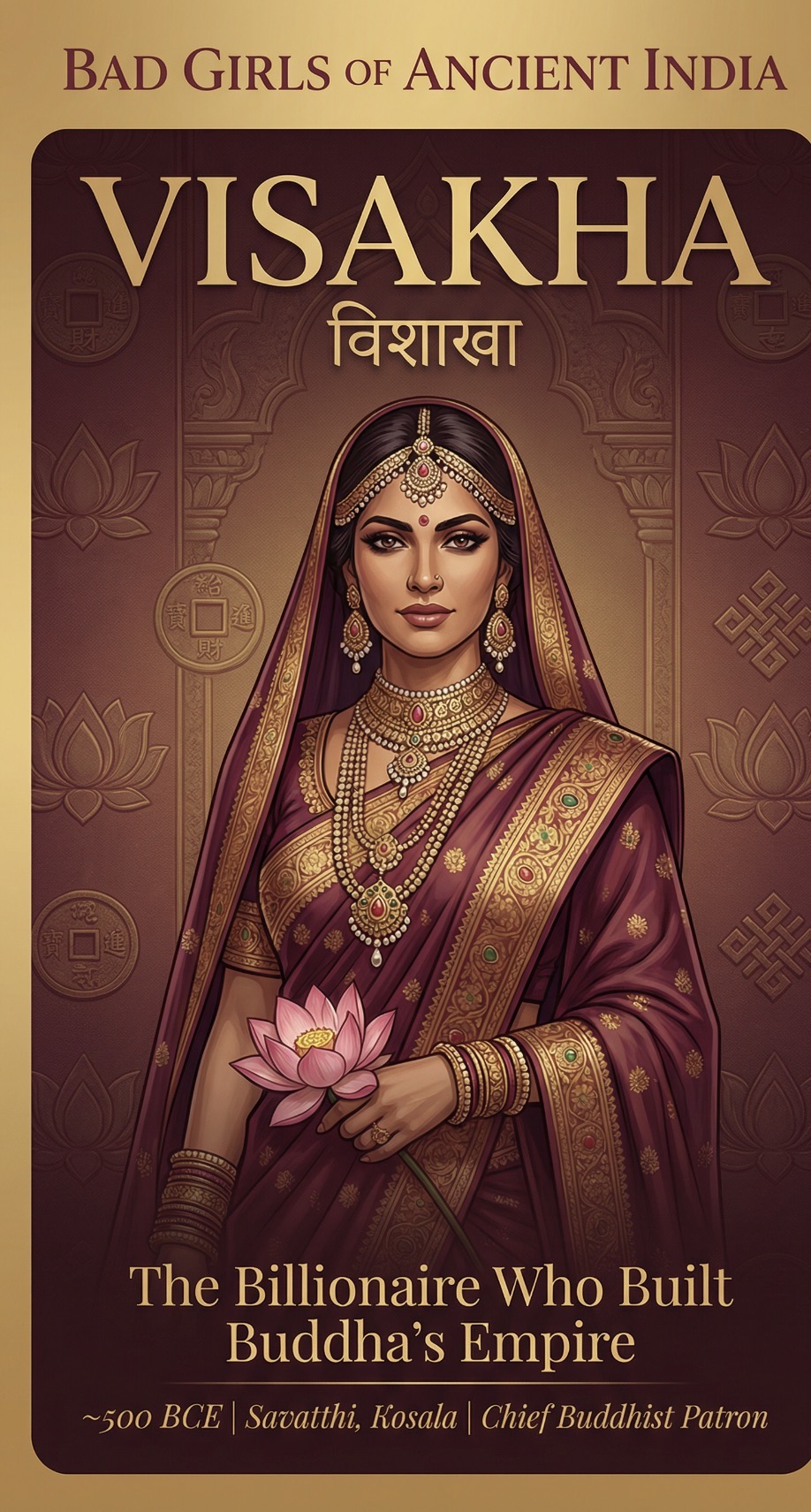
Savatthi, 500 BCE. The richest city in the known world. Every king wanted her favour. Every merchant feared her name. She was 7 years old when she first impressed the Buddha.
Visakha
The Billionaire Who Built Buddha's Empire
Not bad. Just unapologetically WEALTHY.
Ancient India at the height of the Magadha Empire. Trade routes stretched from the Mediterranean to China. The Buddha was alive, teaching, and changing the world. Visakha was about to change it further.
"She was born into wealth — but she didn't stop there. She married into more.
She negotiated her own dowry. At the age of seven, she impressed the Buddha himself with her wisdom.
She funded the construction of the Pubbarama monastery — one of the largest in the ancient world — entirely from her own wealth. The cost? Her legendary jewelled ornament, so precious that no merchant in the city could afford to buy it.
She didn't just donate. She negotiated. She set conditions. She built institutions that outlasted empires.
She proved that wealth is not power. What you build with it is.
Savatthi (modern Shravasti, Uttar Pradesh, India) — capital of the Kosala Kingdom, one of the 16 Mahajanapadas. Located on the banks of the Rapti River. In Visakha's time, it was the wealthiest city in the subcontinent, a crossroads of trade routes connecting the Ganges plains to the northwest frontier.
Visakha mahupasika, danapatini, Buddhassa aggasavika.
Visakha, the great lay devotee, the foremost giver, the chief female disciple of the Buddha.
— Pali Canon, Anguttara Nikaya — recorded c. 500 BCE
I did not give my wealth to the Buddha. I invested it in the future. There is a difference.
— Visakha
Portrait · Story · Map · Family Tree · Power Play Stats — tap to go full screen
Tap a card to explore
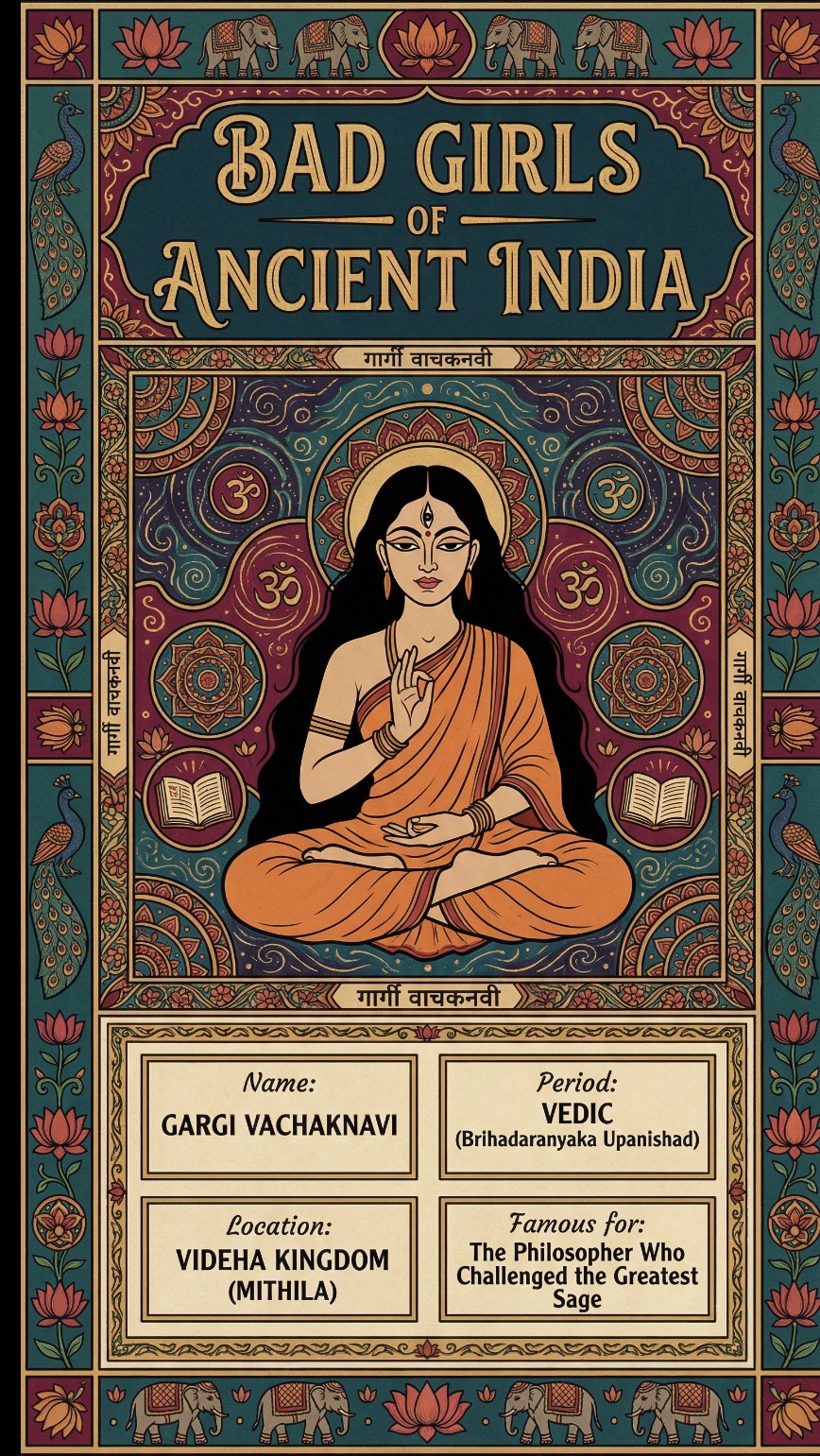
Mithila, 700 BCE. The greatest philosophical debate of the ancient world. Eight sages. One king. One thousand cows as prize. Seven sages had already lost. Then a woman walked in.
Gargi Vachaknavi
The Philosopher Who Asked the Question No One Dared Ask
Not bad. Just unapologetically BRILLIANT.
The Vedic age of the Upanishads — when India's greatest minds gathered at royal courts to debate the nature of reality itself. King Janaka of Videha was a philosopher-king who deliberately invited women to compete. Gargi was about to ask the question that would stop the greatest sage of the age in his tracks.
"King Janaka held the Brahmayajna — a grand philosophical tournament with 1,000 cows as prize. Eight of India's greatest sages entered. Seven were defeated by Yajnavalkya.
Then Gargi rose. She didn't ask about the gods, or the soul, or the afterlife. She asked: 'What is space itself woven upon?' Not what's in space — what space itself is made of.
Yajnavalkya answered brilliantly. But when she pressed further — deeper, closer to the ultimate truth — he warned her not to proceed, lest she 'lose her mental balance.' She had reached the edge of what words could describe.
She conceded gracefully: 'No one will defeat him in any argument concerning Brahman.' Then she was honoured as one of the Nine Gems of the king's court — the only woman among them.
She didn't just ask questions. She asked the question that defined the limit of human knowledge — and was celebrated for it.
Mithila — capital of the Kingdom of Videha, corresponding to modern Sitamarhi district, Bihar, India (near the Nepal border). In the 8th–7th century BCE, Videha was one of the most intellectually progressive kingdoms in the subcontinent. King Janaka's court was a deliberate gathering place for the greatest philosophical minds of the age — and he invited women.
Yajnavalkya, iti hovaca, aham tva dvabhyam prashnabhyam prcchami, tau cen me vakshyasi, na vai te jatu kascid brahmodyanam jeteti.
'Yajnavalkya,' she said, 'I shall ask you two questions. If you can answer them, no one in this assembly will defeat you in debate about Brahman.'
— Brihadaranyaka Upanishad 3.6 — composed c. 800–500 BCE
They told me not to ask too many questions. So I asked the one question that had no answer. That is how you win.
— Gargi Vachaknavi
Portrait · Story · Map · Family Tree · Power Play Stats — tap to go full screen
Tap a card to explore
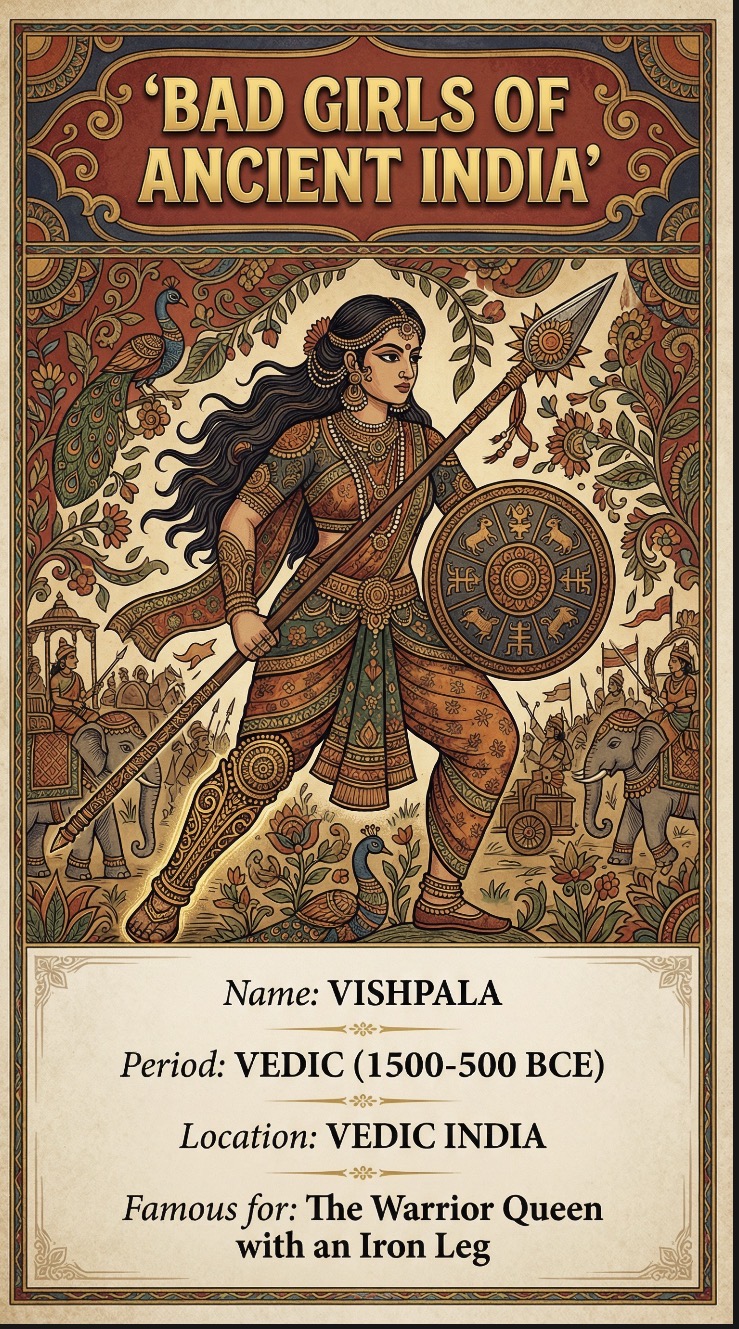
1500 BCE. A battlefield somewhere in Vedic India. A warrior loses her leg mid-fight. Most would leave the field. Vishpala asked the gods for iron.
Vishpala
The Warrior Who Returned with Iron
Not bad. Just unapologetically UNSTOPPABLE.
The Vedic period — the age of the Rig Veda, the oldest religious text still in active use anywhere in the world. A time when gods walked among warriors and hymns were weapons. Vishpala was about to become the first person in recorded history to use a prosthetic limb.
"She lost her leg in battle. The Rig Veda records it plainly, without drama — because for Vishpala, it wasn't the end of the story.
The Ashvins — the divine twin physicians of the Vedic world — forged her a leg of iron. Not wood. Not leather. Iron.
She returned to battle. The Rig Veda hymn that records this is not a lament. It is a celebration.
3,500 years before the first modern prosthetic limb, an Indian woman was already running on iron.
She didn't just survive. She became the reason a hymn was written. 3,500 years later, we're still reading it.
Vedic India — the Sapta Sindhu ('Seven Rivers') region, corresponding to modern Punjab and northwestern India/Pakistan. The heartland of the Rig Veda civilisation, where the earliest Sanskrit hymns were composed and sung. Vishpala's battle took place somewhere in this vast, contested landscape of river valleys and tribal kingdoms.
Vishpalayai shardam ivayasim padam dadathuh.
To Vishpala, you gave an iron leg, swift as a bird.
— Rig Veda 1.116.15 — composed c. 1500 BCE, the oldest religious text in continuous use
They gave me iron. I gave them a reason to write it down for 3,500 years.
— Vishpala
Portrait · Story · Map · Family Tree · Power Play Stats — tap to go full screen
Tap a card to explore
The Power Play Card Game
100 character cards. Compare Courage, Wisdom, Influence, Legacy, and Rebellion. The history lesson that doesn't feel like one.


Meet the Bad Girls
Each one unapologetically herself. Each one a blueprint for power.
Vishpala
Unapologetically UNBREAKABLE
Gargi
Unapologetically BRILLIANT
Visakha
Unapologetically WEALTHY
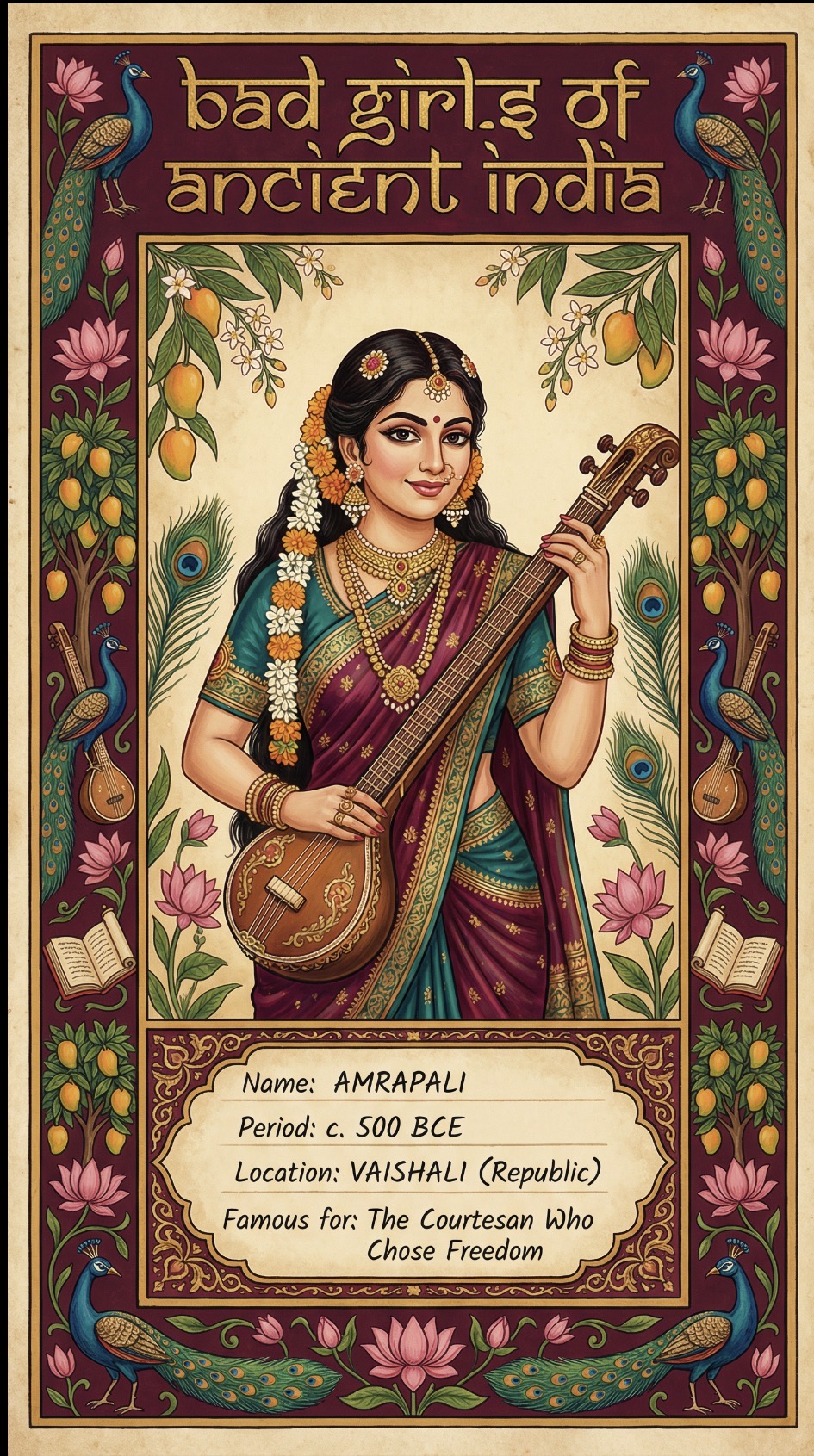
Amrapali
Unapologetically FREE
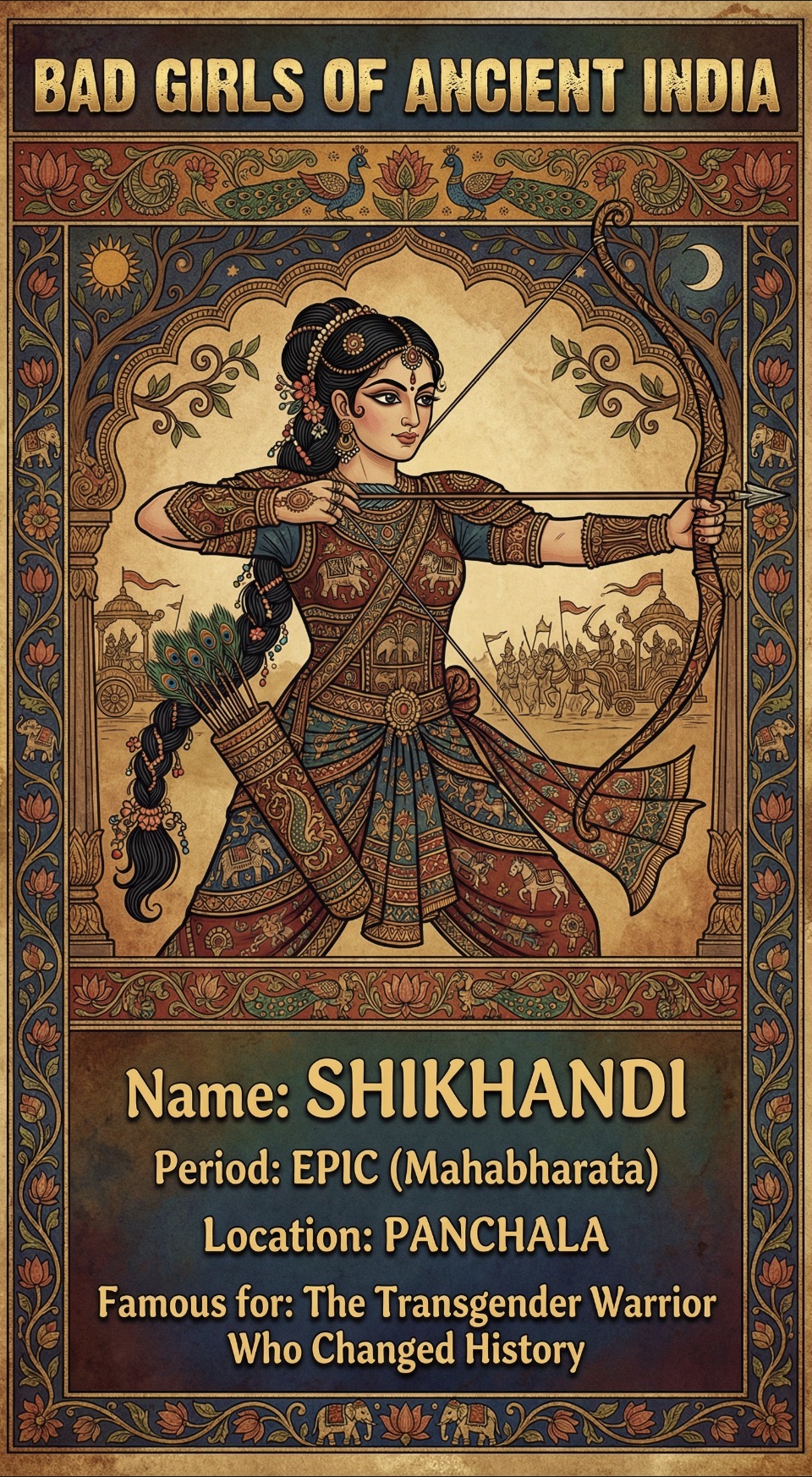
Shikhandi
Unapologetically THEMSELVES
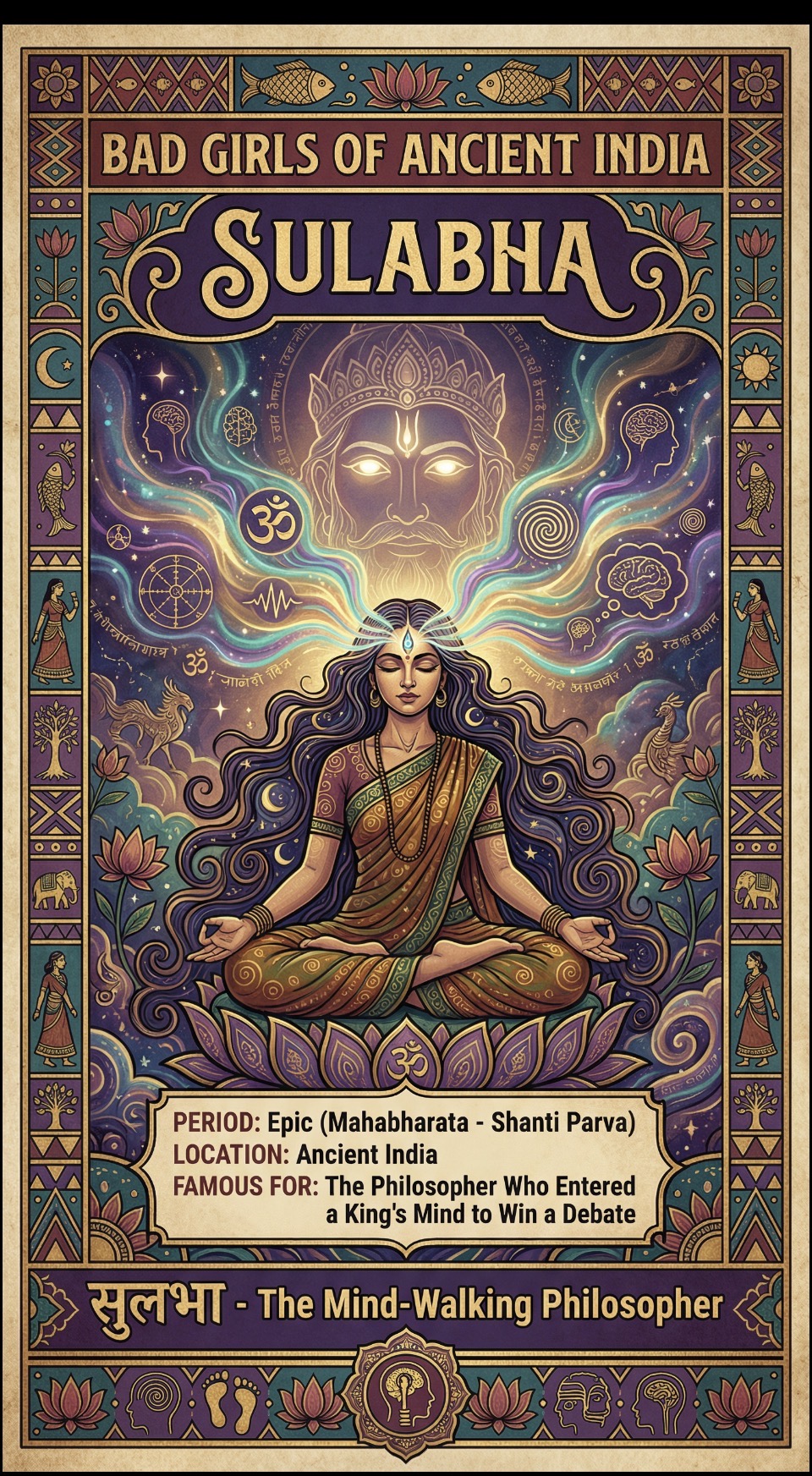
Sulabha
Unapologetically WISE

Draupadi
Unapologetically FIERCE

Lopamudra
Unapologetically BOLD
+ 92 more waiting to be discovered
World Firsts.
All Indian Women.
These aren't myths. These are documented in texts older than the Bible, the Quran, and the Iliad combined.
First Recorded Prosthetic Limb in History
Vishpala
Lost her leg in battle. The gods forged her an iron one. She returned to fight. ~1500 BCE.
Source: Rig Veda 1.116.15
First Recorded Transgender Warrior
Shikhandi
Born female, lived as a man, fought in the Mahabharata war and brought down the greatest archer of his age.
Source: Mahabharata, Udyoga Parva
First Recorded Female Billionaire Philanthropist
Visakha
Built hospitals, rest houses, and funded an entire religious movement. Her wealth was legendary even by royal standards. ~500 BCE.
Source: Pali Canon, Vinaya Pitaka
First Recorded Female Philosopher to Debate a King
Gargi Vachaknavi
Walked into a royal assembly of 1,000 male scholars and challenged the greatest philosopher of the age — twice. ~700 BCE.
Source: Brihadaranyaka Upanishad 3.6, 3.8
First Recorded Female Author of Vedic Hymns
Lopamudra
Composed hymns in the Rig Veda — the oldest religious text in the world — still recited today. ~1500 BCE.
Source: Rig Veda 1.179
First Recorded Woman to Choose Freedom Over a Crown
Amrapali
The most desired woman in the kingdom. Refused kings. Chose her own path. Then gave it all up for enlightenment.
Source: Pali Canon, Therigatha
What Women Are Saying
"Across ancient Indian texts and time, are many women who broke the glass ceiling but were largely forgotten, ignored, or misunderstood. It's heartening to see these women finally being highlighted and given the respect they truly deserve. I am surely pre-ordering!"
Sangeetha Ranganath
Indian Mythology Enthusiast
"I would pre-order Bad Girls of Ancient India because the fiercest women in history deserve to be remembered, reclaimed, and re-read!"
Shruti K.
Entrepreneur & Auntie in Chief
"A very novel and RAD concept that so quirkily merges the ancient with the contemporary! Relatable to the youth and simultaneously educational — we NEED to pass on ancient stories to our progeny. The value is priceless. Go order NOW!"
Archana Kumar
Mum · Founder, Arch Ensemble · Kathak Dance Exponent
115 women
have already pre-ordered
Join them. No payment required — just your name and email.
Join the Movement
Secure your early bird spot. No payment required — we'll contact you when the book is ready.
Free to pre-order · No payment now · Be first to know at launch